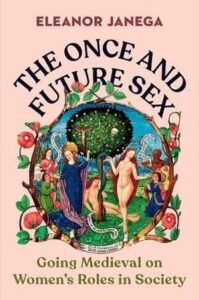

The Once and Future Sex: Going Medieval on Women’s Roles in Society
Eleanor Janega
“When we ignore history like this and assume that women have always been treated in one particular way that we are only now beginning to overcome, we accept that our society has always been this way and indeed should be this way.”
For most of history, women have been defined in relation to men…and found wanting. This is as true today as it was hundreds of years ago, although perhaps for different reasons. In The Once and Future Sex, medievalist Eleanor Janega turns back the clock to lay bare the roots of misogyny and show how the expectations placed on women have changed (or not), and how knowing more about the past might help us create a more equitable future.
I had to read this book twice: the first time to get the gist, the second to fill the pages with Post-Its covered in notes. Janega does a fantastic job of tracing the threads of gender beliefs up from ancient times into the Middle Ages and beyond. There’s too much to cover in a short review, but her theory is that our hesitancy to question ancient teachings or declare them incorrect has given us an incredibly flawed foundation on which we’ve based much of western culture. I can’t believe Janega packed so much complicated history into 270 pages, and I’ve spent the last few weeks resisting the urge to shout rage-inducing facts in the town square. This one’s going on my “keep and re-read” shelf.
Pick this up if you love hidden history and are prepared to get furious.
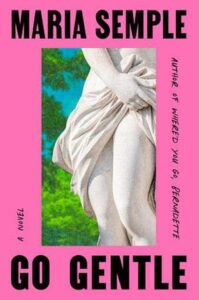

Go Gentle
Maria Semple
“Acceptance isn’t passive. It’s active. Acceptance is an act of courage. It’s not the end. It’s the beginning.”
Adora Hazzard (yes, that is her real name) lives contentedly in New York’s Upper West Side. Her younger years were tumultuous, but middle age and her philosophical studies have shown her the value of living well. Her plan is to continue quietly on, but the universe has other plans. A chance encounter kicks off a series of events that get weirder by the day, and soon Adora finds herself wanting more than her life can give. What will she risk to get it?
While I liked this concept and many of the themes, the disjointedness of the reading experience was too much for me to look past. It felt like Semple started out writing a book about a middle-aged woman’s philosophical experiences, then switched abruptly to international espionage. Suspension of disbelief can only take me so far. I decided to let the plot do its thing and focus on the character study aspects — Adora is interesting and strong and flawed, and I liked reading her take on Stoicism.
Give this a shot if you’re looking for adventure…just don’t expect it to feel at all realistic.
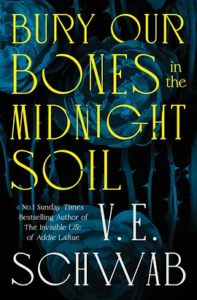

Bury Our Bones in the Midnight Soil
V.E. Schwab
This review contains spoilers.
“Bury my bones in the midnight soil, / plant them shallow and water them deep, / and in my place will grow a feral rose, / soft red petals hiding sharp white teeth.”
Although their lives are separated by hundreds of years, Maria, Charlotte, and Alice have something in common: they want more than their small lives are offering. But freedom comes with a terrible price.
As a millennial still slightly traumatized by Twilight, it’s been awhile since I picked up a vampire book. But I’ve been meaning to read a Schwab novel and my book club selected it for June, so here we are. I didn’t love that the author prioritized flowery language over plot (in a way that eventually became grating). However, in the end the themes were what kept me mulling over the story after the last page. Women experience hunger, control, love, rage, and loneliness in unique ways, and Schwab draws interesting parallels with the classic vampire as a framework. The general feeling from my book club is that the prose is excellent, but that the book could have been tighter and we wish there could have been more likeable characters.
This one was interesting to talk with others about, even if the reading experience leaves you feeling a little “meh.”


Planet Money: A Guide to the Economic Forces That Shape Your Life
Alex Mayyasi
“Our favorite way to answer economic questions, large or small, is through stories. Watching real people make real choices is the purest way to understand the economic forces acting on us, from the omnipresent ones like the laws of supply and demand behind food prices, down to obscure but powerful effects like ‘cost disease’ that explains why haircuts and health care get more expensive while TVs get cheaper.”
Stories and research from the archives of the Planet Money podcast about everything from the basics of how economies work to whether all jobs will vanish due to automation.
Anyone who says economics is boring isn’t reading the right stuff — and this is definitely the right stuff. Mayyasi (and the team with him) has a knack for telling the human stories behind complex concepts; I appreciate how they distill things down to their essence. While I wouldn’t consider every topic applicable to me specifically (I can’t control inflation or supply and demand), the sections on work, saving, and investing gave me interesting things to chew on.
Add this to your TBR if you’re looking for a relatively low-effort way to understand economics and how the way the world works can impact you.
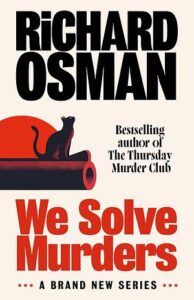
We Solve Murders (We Solve Murders #1)
Richard Osman
“It’s not every daughter-in-law who will high-five you when you’ve shot a drug dealer in a Coldplay T-shirt, is it?”
Retiree and widower Steve Wheeler enjoys his routine: morning walks, lunch with his cat, and quiz night with his friends down at the local pub. He’s content to live vicariously through his daughter-in-law Amy, a professional bodyguard. But when a series of high-profile murders are staged to implicate Amy, the duo embarks on a global adventure to uncover the real killer. Along the way they meet an author who may have a bounty on her head, easily distracted pensioners, and a series of sneaky people who could be friend…or foe. Can they find out the deadly truth before it’s too late?
Like many others, my first encounter with Osman was The Thursday Murder Club. This first in a new series continues the theme of oddball characters teaming up to solve crimes — clearly something that’s right up my alley. Simply put, this was a fun read. The stakes were high and the plot enjoyable, but everything was wrapped in a just-cozy-enough vibe that I never worried about any of the sweet characters to which I’d been introduced. The second in the series, We Chase Shadows, is set to publish later this year, and I’ll be happy to pick up a copy.
Try this if you like a fun cast of characters and just a touch of silliness with your murder mysteries.
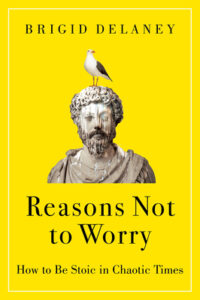
Reasons Not to Worry: How to Be Stoic in Chaotic Times
Brigid Delaney
“In ancient Stoicism I found people, just like us, longing to find meaning and connection, to feel whole and tranquil, to love and be loved, to have a harmonious family life, fulfilling and meaningful work, intimate and nourishing friendships, a sense of contributing to your community, belonging to something greater than yourself, a wonder at the natural world, flashes of deep awe, a head full of questions about how it all came to be, and, finally, coming to terms with letting it all go—at some point, not of your choosing.”
The last several years have been more than a little weird and awful. Coping mechanisms have varied, but a not insignificant number of people have turned to philosophy, in particular Stoicism. Reasons Not to Worry is the result of journalist Brigid Delaney’s year spent studying this ancient approach to life, death, and everything in between.
As a practicing Stoic and all-around Nosy Nelly, I’m always going to want to read about other peoples’ perspectives on this philosophy. I enjoyed reading about Delaney’s experiences, and love that she found a “buddy” to discuss concepts and personal scenarios with. The book doesn’t get into the minutiae as much as something like Sellars’ Stoicism, but it’s a great way to get a grasp on the theory using real-world examples.
Read this if you’re looking for an easy way into studying this most practical philosophy.
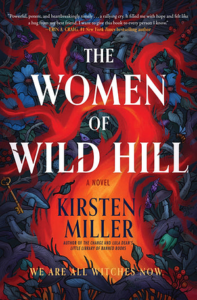
The Women of Wild Hill
Kirsten Miller
“We topple tyrants, right wrongs, and restore the earth. We are the oracles who tell the future. We are the temptresses who taste the apple. We are the women who balance the scales.”
The property known as Wild Hill has belonged to the women of the Duncan family for centuries, but has sat abandoned since sisters Brigid and Phoebe lost their mother to an alleged suicide. But a series of unnatural deaths and hard-to-ignore messages have forced them, along with Phoebe’s daughter Sibyl, to return. The Old One has been gathering strength for an assault on those who have chosen paths of greed, exploitation, and destruction — and it will be up to the Duncan women to turn the tide.
I read Miller’s novel The Change last year and may have made it my entire personality for several months. The Women of Wild Hill focuses on similar themes of female power, but dives deeper into the world Miller is building with these novels. This isn’t officially a sequel, but the location and character crossover are setting readers up for some really interesting future situations. My only quibble is that it leans a little too much into the “all men are trash and we hate them” plot point. I’m not saying there aren’t terrible men who exploit and harass, but I think women are equally capable of being garbage human beings. I have no idea if Miller is planning to continue writing in this world, but if so I’ll be in line on day one to read it.
Perfect if you like powerful but flawed women, intriguing world building, and horrible men getting exactly what they deserve.
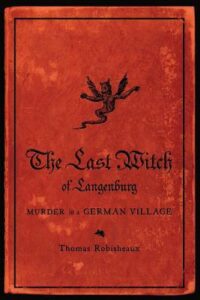
The Last Witch of Langenburg: Murder in a German Village
Thomas Robisheaux
“Her fate, I learned, was intimately connected to the world of the universities: fierce debates about evidence and proof, controversies about poisoning and the emerging science of forensic medicine, and arguments over the nature of politics, religion, and the state.”
On February 20, 1672 in the southern German village of Langenburg, a new mother died. Was it the result of an undiagnosed post-birth infection, or was she poisoned — and by whom? The investigation occurred at an historical crossroads when reason and scientific understanding were held back by outdated beliefs and superstition. Robisheaux walks the reader through historical context, court records, eyewitness accounts, and even a proto-autopsy report to unspool the case of Anna Schmieg, the last witch of Langenburg.
In a classic case of bookish serendipity, I picked this book up at Alienated Majesty Books while touring the Austin Texas Book Trail earlier this year. I had no idea it was going to keep me up well past my bedtime and become my newest obsession.
The book is impeccably detailed, which shouldn’t be a surprise given that the author has “particular interests in social and cultural history, German-speaking Central Europe, Renaissance culture, religious reform, popular religion and culture, and microhistory.“ It’s academic-level writing that’s easy to read — quite the feat.
I went in expecting this to be a typical story of “woman is accused of witchcraft because she annoyed or freaked out some dude and they have to kill her to make themselves feel better.” But what Robisheaux does is use the stereotypical witch hunt as a way to dive into how criminal investigations were changing. Autopsies were becoming more important, how people were questioned was becoming more logical, and witchcraft was—gasp, I know!—less often considered a crime. But of course old habits die hard, and Robisheaux spends an equal amount of time discussing how community and cultural structures, as well as “proper” uses of torture to secure “true” confessions, impacted Schmieg’s case. All in all a fascinating and unique look at a well-traversed subject.
If you like history and true crime, this book is for you.
Photo by Leslie Cross on Unsplash