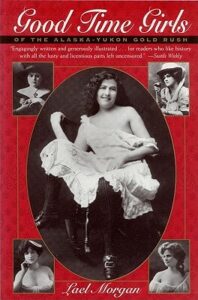

Good Time Girls of the Alaska-Yukon Gold Rush
Lael Morgan
“ ‘Guys, if you’re not ready, don’t stand in line!’ “
Prospectors weren’t the only ones who headed north during the gold rushes of the 19th and early 20th centuries. Women couldn’t stake claims, but many were willing to sell whatever talents they had to men with deep pockets. Good Time Girls tells the stories of just some of the women who had the courage and perseverance to live — and in many cases thrive — in the Far North.
I saw this on the shelf at Skaguay News Depot & Books and had to buy it because with that cover how could I not? I love reading about tough, smart women, and Good Time Girls has those in spades. The amount of gumption these ladies had to leave civilization, travel dangerous routes, live by their wits, and become entrepreneurs in the early 1900s is incredible. Not everyone lived happily ever after, but those who stayed had a lasting impact on Alaska, the Yukon, and all the women who came after them.
Read this if you like history and stories about badass women.
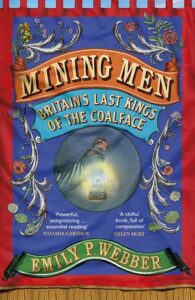

Mining Men: Britain’s Last Kings of the Coalface
Emily P. Webber
“When we are asked who made Britain great, alongside a history of kings and queens, colonisation and subjugation, and wars that wiped out generations, we should remember the miners.”
For hundreds of years, men labored deep underground to mine the coal that kept Britain’s fires lit. They endured heat, backbreaking work, and constant danger; in return they were underpaid, abused by police, and died in droves trying to breathe with lungs coated in black dust. They relied on each other through good times and bad, and did their damnedest to make sure their contributions won’t be forgotten. These are just a few of their stories.
The little I know about the coal industry comes from countless rewatches of October Sky, so this was an interesting way to augment that knowledge (albeit about somewhere other than America). Many of the men Webber spoke to are second generation, lifelong miners bound to the earth and each other by what they faced underground. The book was published in Britain and assumes the reader knows more about Margaret Thatcher and the miners’ strike of 1984-85 than most Americans probably do, but it doesn’t take away from the point the author is trying to make. Men like these build countries, and their sacrifices should be honored.
Try this if you want to learn more about some of the history that’s shaped Britain.
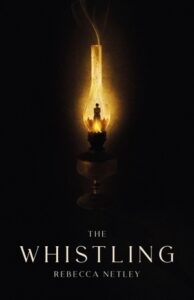

The Whistling
Rebecca Netley
“The world gives birth to both the viper and the lamb, and there are churches for each.”
When Elspeth Swansome arrives at Iskar House, she’s disturbed to learn that her charge, Mary, has not spoken a word since the day her twin brother died. The house is dreary and mostly shut up, but Elspeth finds respite from the gloom by exploring the island and making friends with several locals. But the past is never really over, and those who left are never truly gone. Soon Elspeth realizes it’s up to her to discover the truths hidden in Iskar — before it’s too late.
What a great way to wrap up spooky season reading! Netley’s book ticks all the best boxes: A fog-drenched island, a haunted house, weird servants, neighbors that are a little too into old folklore, and a heroine with a spine of steel. The build up had me wound tight as a bow string, and although the ending felt a little rushed I still enjoyed every moment.
If you’re looking for a book with oodles of oppressive atmosphere and a dash of mystery, you’ve come to the right place.
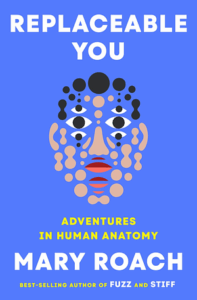
Replaceable You: Adventures in Human Anatomy
Mary Roach
“Up through the 1940s, donor centers would set up chairs alongside arm-sized holes cut into a wall-sized partition. Donors would slide their arm through a hole, making a donation without ever having to see the blood, the needle, or the phlebotomist sitting on the other side. Blood bank glory holes!”
If someone asked you to list types of complex machinery, “the human body” probably wouldn’t be the first thing you wrote down. But the bits and pieces that comprise a human — even if you don’t consider the brain — are so specialized and miraculous that we’ll probably make it to Mars before we’ll figure out how to make like-new parts for ourselves. In her ninth book, author Mary Roach leads readers on a wild adventure through the science of human body maintenance. Whether you’re in the market for a new nose, want to move some hair around, or need the 3D printer file for a replacement kidney, Roach has the info you’re looking for.
I still consider stumbling across a copy of Stiff: The Curious Lives of Human Cadavers at a bookstore as one of the greatest moments of my reading life. Years later Roach has brought another buckass-wild book to life, and I am here for it. Hanging out in an iron lung! Visiting a sterile pig farm! Turning a finger into a penis! Butt stuff! What’s not to love? Roach is known for her curiosity and appreciation for the wonderful but weird, and that shines through here. The science got a wee bit deep for me, but it was still an interesting, giggle-inducing experience.
Add this to your TBR if you like funny science adventures — and never skip the footnotes.
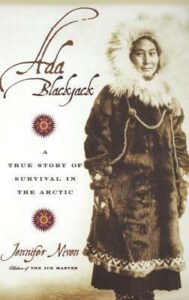
Ada Blackjack: A True Story of Survival in the Arctic
Jennifer Niven
“If she did not get up out of bed to forage for food, she would go hungry. If she did not light the fire, it would remain unlit. If she did not bring in the snow, there would be no water to drink. Eventually she grew tired of crying and pitying herself. She must get up and make another boat, and so she did.”
In the fall of 1921 a small group of explorers landed on Wrangel Island, determined to claim the land for Canada. Two years later the first relief ship to make it through the ice rescued a lone survivor: 25-year-old seamstress and cook Ada Blackjack. Hailed as a hero by some and an opportunistic villain by others, Ada spent the rest of her life trying to forget her ghastly time in the Arctic. But the truth of what happened on Wrangel Island wouldn’t remain hidden for long.
I picked this up at Skaguay News Depot & Books — and it made me very glad I was cozily ensconced on a cruise ship instead of dumped on an icy island with four mostly useless dudes who were in turn hired by a guy who should have been in prison. This is the story of a woman who, after watching her remaining companion die slowly from scurvy (Google that at your own risk), realized her options were to lay down and die or figure it out — and decided to do the latter. Ada wasn’t perfect, but she was strong and insanely determined, just the kind of person I love learning about. Niven’s book relies on the explorers’ journals, contemporary press coverage, and interviews with Ada’s surviving son to tell an incredible story of survival against all odds.
Give this a try if you like reading about strong, flawed women and the heyday of Arctic exploration.
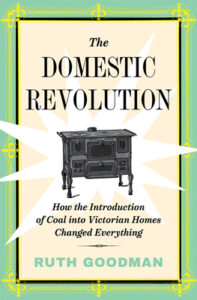
The Domestic Revolution: How the Introduction of Coal into Victorian Homes Changed Everything
Ruth Goodman
“A seemingly mundane domestic decision about how people heated their homes and cooked their food had profound consequences. It became the foundation of the modern economy, altering the landscape, promoting the rise of global industries and shaping cultures.”
According to most history books, the Industrial Revolution began (at least in the West) in 1760. Researchers pinpoint this year as the point when technological innovation tipped us into what would soon become the modern age. However, in her book The Domestic Revolution, historian Ruth Goodman posits that the Industrial Revolution has its roots several hundred years earlier — when private citizens made the “big switch” from wood to coal. This change began a cascade that would soon alter every aspect of our lives for generations to come.
Photo by Louise Pilgaard on Unsplash