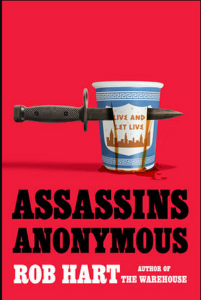

Assassins Anonymous (Assassins Anonymous #1)
Rob Hart
“That’s why we’re here, dumbass. You can feel bad, and you should. Now you sit with those feelings and take the next right action. Meanwhile, I forgive you, because the person you were then isn’t the person you are today. Welcome to recovery.”
Thanks to a secret group for reformed killers, Mark has been on the wagon (so to speak) for almost a year. But when a blitz assault leaves him bruised and bleeding, he knows it’s time to get out of New York. He doesn’t know whose radar he’s popped up on, but they sure seem determined to take him out. Killing is against his new code, but being killed would really put a damper on things. What’s a retired assassin to do?
As a mystery/thriller connoisseur, I’m always on the lookout for stories that come at this sometimes-repetitive genre from a new angle. “Killer who’s tired of killing” isn’t necessarily unique, but I hoped I’d find the parallels between alcoholism and murder interesting. Like anyone else facing addiction, Mark believes he can quit at any time — but spends most of the book giving in to his baser instincts. The thriller aspects are solid, with a few twists that were so good it makes the “big reveal” fall kind of flat. But mostly I stuck around to see what kind of knots Mark could tie himself into trying to justify his actions.
Add this to your TBR if you’re looking for a study in addiction masked as thriller brain candy.
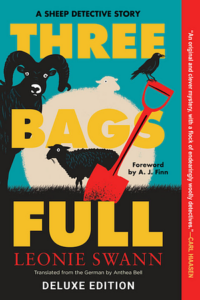
Three Bags Full (Sheep Detective Story #1)
Leonie Swann
“Maple thought optimistically that human beings, on their good days, weren’t much dimmer than sheep. Or at least, not much dimmer than dim sheep.”
Something is definitely wrong with George the farmer. It could be that he’s lying on the ground, or because he’s not moving, but the sheep leaning over him are pretty sure it’s got something to do with the spade sticking out of his chest. George has apparently been murdered — but by whom? And why? Determined to solve the mystery, his flock begins an investigation that will take them on an adventure bigger than any of them could have imagined.
My book club chose this novel because we were looking for something a little weird, and what could be weirder than sheep solving a murder? Sadly I think most of us came to the conclusion we’d been the victims of a bait-and-switch blurb. George is dead and the sheep do investigate, but those aspects are far less of a focus than the sheep themselves. I would have enjoyed it more had I known this from the start. Swann’s book is a perfect example of a character study…except the characters happen to be sheep. And they’re fun, funny characters! The way they see the world and the foibles of humans is interesting and entertaining. But the murder is superfluous, and I didn’t want it to be. A nice enough read, but I won’t be continuing the series.
Give this a shot if you like character studies (of unique characters) and don’t much care about the murder angle.
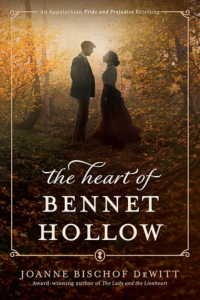

The Heart of Bennet Hollow
Joanne Bischof DeWitt
“ ‘Did you spot the new train car, by chance?’ Jayne asked from the table, her voice as soft and mountain grown as a wild birch grove.”
It’s the fall of 1904, and the town of New River, Virginia is abuzz. The local mine owner is retiring, and a series of coal barons are descending to place their bids for ownership. Among them is William Drake, who arrives determined to keep his distance from the townspeople — especially the members of the Bennet family. Lizbeth wants to preserve and improve her family’s farm, but her primary option — marriage — feels too limiting for a spirited young woman. When their tenuous friendship is ruined by a shocking revelation, William and Lizbeth will have to decide whether to listen to their heads…or their hearts.
I really need to stop reading Pride and Prejudice retellings; Austen did it first and best, and anything else is a pale imitation. I thought the Appalachian setting would be interesting, but the only thing it brought to the story was that cheesy “moonlight and magnolias” vibe that makes Southerners roll their eyes. DeWitt stripped away all the humor, flattened the characters, and lowered the stakes, then sprinkled in enough of a Christian fiction angle that I nearly gave up on the book entirely. Total bummer.
Just…just read Jane Austen, y’all.


This is Not a Book about Benedict Cumberbatch
Tabitha Carvan
“That’s what my beloved book on pop fandom said about the gender disparity in music journalism. Women mature out of their pleasures. Men, on the other hand, get to hang on to theirs, turning them into lifelong passions, or even better, a career. Then they get to make cute jokes about how they never grew up.”
Tabitha Carvan’s life changes the day she realizes she is Benedict Cumberbatch’s new biggest fan. The obsession appears out of the blue, with confusion and shame fast on its heels. She’s happily married! A mother! A grown woman who should have “grown out of” such things! But the more Carvan connects with fellow obsessives, the clearer it becomes that Cumberbatch is a stand-in for the idea of loving something, anything, just because you can. Women in particular are expected to set aside whatever brought them joy in adolescence in favor of more “appropriate” joys like getting married, raising kids, and keeping a home running. Carvan argues that embracing our interests, even if others might think they’re weird, is key to being fully human.
One of the nice things about getting older is that I’m learning to care less about what other people think of me. I want to be a good person and live by my values, of course, but these days I feel more comfortable being myself even if people think I’m weird. Seeing books like Carvan’s is exciting because it means that others are starting to think that way too — especially women. Being human can be absurd and awful, and none of us make it out alive anyway, so why not lean into what brings us joy? I wish the author had brought in more examples of people finding joy in things other than Mr. Cumberbatch, but it’s not reasonable to expect a first-time author with no research background to whip out a sociological deep dive. Overall Carvan makes her point well, and I’m glad to read about women finding things they love.
Add this to your TBR if you’re looking for more reasons to be your weird little self (not that you need them).
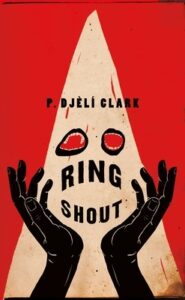

Ring Shout
P. Djèlí Clark
“When the Klans ride in all gallant on their horses to save the day, white folk go wild—’like a people possessed,’ newspapers say, which ain’t too far from the truth.”
In the post-Civil War era, a group known as the Ku Klu Klan has re-risen to power. Most members are garden-variety racists, fearful and insecure; Maryse Boudreaux and her companions can see who some of them really are. The KKK leaders have dabbled in conjuring, resulting in an unholy pact with something far beyond their comprehension. As an auspicious night draws near, Maryse knows her people must make their last stand atop Stone Mountain. But can she save the future without first facing her past?
I didn’t know I could hold my breath for five hours, but that’s exactly how I felt listening to this novella. Clark throws you in on page one and doesn’t let up until the epilogue.
The root of the story (girl kills monsters) is common in fantasy, it’s the themes and details that make it sing. In this America hatred is a parasitic infection, powerful people are corrupt and seek to corrupt others, and fighting it all can seem hopeless. The truly frightening idea, of course, is that the line between Clark’s alternate and our current world becomes dangerously blurred. We feed on anger too, and the results can be devastating. Listening to this on audio was the right choice — narrator Channie Waites makes Clark’s words flow like spoken word poetry, speaks Gullah slang in a way that clearly conveys its meaning, and portrays the cacophonous monsters with well-crafted creepiness. Ring Shout kept me up past my bedtime and — like Nethercott’s Thistlefoot — has got me thinking about the power of emotions and memory.
Read this if you’re looking for something short that packs a stinging punch, and aren’t afraid of gore.
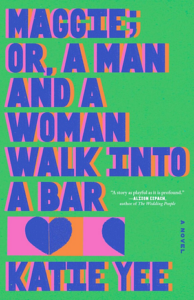

Maggie; Or, a Man and a Woman Walk Into a Bar
Katie Yee
“You’re never too old to be afraid of what you can’t see.”
Just a few weeks after hearing what she thought were the world’s words (“I’m having an affair”) a young mother experiences the heart-stopping panic of, “You have cancer.” The unnamed narrator decides to lean into the chaos and names her tumor after her husband’s mistress — after all, both are ruining her life. A quiet study of grief, healing, and finding ourselves again.
Normally I’m not a fan of a cheating spouse plus cancer plot, but the premise of this novel intrigued me enough to give it a try. I should have listened to my gut. I think Yee fell into the trap of many first-time authors by trying to be so deep that everything bottomed out. I could never get a sense of the main character’s personality or understand her decisions. She doesn’t even get a name, which I think is meant to make the reader put themselves in her shoes but actually just makes her feel more distant. In my own personal most frightening, numbing situations I’ve always tried to freaking do something. The main character has no fire, nothing to make me root for her. She never asks her husband why, never pushes him to be a better parent, she even outsources cancer treatment research to her friend. Perhaps I would have gotten more from the story if I were a parent, a divorcee, or dealing with a scary illness — but as it is I just found the story kind of bland. It was also stream-of-consciousness, never my favorite. Not terrible, but not a good read for me.
Consider this if you enjoy heavier themes and don’t mind a potentially unlikable main character.
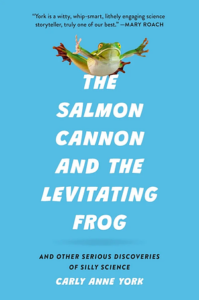
The Salmon Cannon and the Levitating Frog: And Other Serious Discoveries of Silly Science
Carly Anne York
“None of this research came from a straightforward plan that was followed to fruition. Ideas sprang from observation, curious minds, inspiration from nature, collaboration across disciplines, and sometimes just from a lucky break.”
Measuring the strength and speed of a mantis shrimp’s punch? Yep. Figuring out how that roach shimmied out from under your shoe and into a crack in the grout? Check. Throughout history and all over the world, scientists have spent a lot of time doing weird stuff. Often their research is done with specific goals in mind; sometimes their discoveries are the result of a simple, “What if…?” The Salmon Cannon is a detailed look at more than 20 examples of when that question led to fascinating discoveries that may revolutionize our world.
I’m a sucker for popular science, and was therefore very excited to dive into York’s debut. While it lacks the humor I love in books like those by Mary Roach, I still had a blast reading about scientists leaning into their curiosity. I appreciate that the author took time to show how these “silly” things have led (or could lead) to improvements in search and rescue, vaccines, all kinds of medical treatment, and even flight and pollution control. At a time when research funding is being hacked away, it’s even more crucial to remember that science, even “silly” science, is worth pursuing.
Perfect for readers who love complex science explained well.
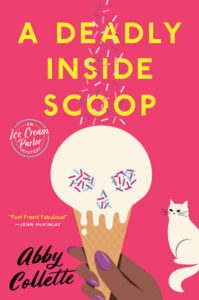
A Deadly Inside Scoop (An Ice Cream Parlor Mystery #1)
Abby Collette
“There had been a murder. And the police thought my father had something to do with it.”
The grand re-opening of her family’s ice cream shop was meant to be a day filled with sweet memories for Win Crewse. Unfortunately the shop is still technically under construction, and opening day is ruined by a freak October snowstorm. Plus of course there’s the body. Turns out the stiff she trips over is well-known to the Crewse family, and for all the wrong reasons. Very quickly, Win realizes it may be up to her to prove her family’s innocence and uncover the real killer…before she herself gets put on ice.
Cozy mysteries are hit-or-miss for me, and I’ve learned the trick is to go in with low expectations and remember that certain setups, characters, and tropes are just part of the genre. But even keeping all that in mind, I had to give this one a 2.5-star rating. The main character, Win, doesn’t feel fleshed out — especially in comparison to her two best friends, who in turn feel very exaggerated. The book also leans hard into miscommunication/deliberate secret-keeping, one of the tropes that aggravates me the most. The story itself was fine, but not interesting enough to make me pick up the next in the series.
Good for readers who enjoy a cozy mystery “brain candy” read.