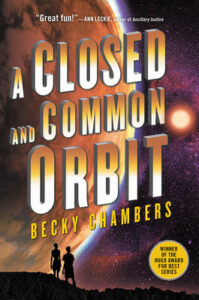

A Closed and Common Orbit (Wayfarers #2)
Becky Chambers
This review contains spoilers for Wayfarers #1, The Long Way to a Small, Angry Planet.
“If you believe you have control, then you believe you’re at the top. And if you’re at the top, then people who aren’t like you … well, they’ve got to be somewhere lower, right? Every species does this. Does it again and again and again. Doesn’t matter if they do it to themselves, or another species, or someone they created.”
Soon after the events of The Long Way to a Small, Angry Planet, Lovelace the AI finds herself with a new body, a new name, and a new home planetside with Pepper the tech shop owner. At first it doesn’t seem like these two have much in common. But soon it becomes clear that they’re both looking for something — and they’ll need to work together to find it.
Chambers has knocked it out of the part, yet again. What could have been a cliched AI-has-to-figure-out-life-in-a-human-body story actually became a study of what it means to be human at all. The addition of Pepper’s story as a dual timeline reinforces that theme, plus gives the reader even more context about the world in which this series is set. It’s serious, but also heartbreaking and sweet. I don’t think it beats the Long Way, but it was a great book to spend time with.
Add this to your TBR if you like character-focused sci-fi. Just maybe have a couple tissues handy.
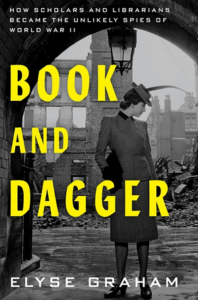
Book and Dagger: How Scholars and Librarians Became the Unlikely Spies of World War II
Elyse Graham
“And so: imagine, please, the world of bookshelves, the smell of old paper, and the sense of expectation that haunts any labyrinth of texts—as if, just by wandering among the stacks, you might chance upon a secret that has eluded everyone else. As magical as it is, this is a world that we often think of as a kind of back room: a place to read about history, not a place where history happens. But it is, and it was. The war may have been fought on battlefields, but it was won in libraries.”
What comes to mind when you think of a spy? Is it James Bond, with his charisma and shaken martinis; or maybe Jason Bourne, with his elite assassin skills? In a hundred years you’d probably never think of people like Joseph Curtiss (English professor), Adele Kibre (archivist), or William Donovan (lawyer). Humanities scholars were overlooked or looked down on by many, including the Nazis — to their eventual regret. Book and Dagger contains the true stories of just a few of the men and women who used paper, pens, and a very specific set of skills to revolutionize intelligence gathering for the modern age.
Sometimes as a reader you come across a book that is so good you can’t stop yourself from hugging it, or that you wish you could read again for the first time just so you can experience it all again. This is absolutely how I feel about Book and Dagger. Graham has done her research, but it’s also clear that she’s passionate about sharing a belief in the power of…well, nerds. Hitler hated those who stood out or thought differently — others saw the advantage of cultivating unique minds. World War II was the first time countries had to rely on more than boots on the ground to gain victory. Information was critical, as was having the ability to turn that information into intelligence. The stories she tells are fascinating, often difficult or downright horrifying, and endeavor to show how the roots put down by scholarly spies have grown into modern organizations like the CIA. Graham quotes historian W.S. Holt when she calls history “a damn dim candle over a damn dark abyss.” I love her contribution to the candlelight.
Read this, read this, read this — especially if you enjoy history that echoes into the future.
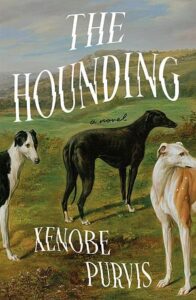

The Hounding
Xenobe Purvis
“Girls—normal human girls—people could contend with; they were weak and small. And dogs too could be trained. But girls who became dogs, or who let the world believe they were dogs, were either powerful or mad: both monstrous possibilities.”
The Mansfield family has never been popular in Little Nettlebed. The patriarch reportedly profited from price gouging during a bad harvest year, and now he’s letting his five granddaughters run wild. They don’t smile, make polite conversation, or seem at all interested in being part of the community. A series of dark omens already has everyone on edge when the local ferryman reports a startling sight: the Mansfield sisters transforming into dogs in the fields outside town. As the tension mounts and rumors spread like wildfire, it becomes clear that the girls may pay an unthinkable price.
Although I wouldn’t go so far as to say I enjoyed this book, it’s definitely stuck with me — and maybe that’s the same thing. Most of the characters are forgettable or downright unlikeable. Which is fine, because it gives Purvis more time to focus on themes like moral panic and how little it takes for women to be considered provoking or rebellious (especially by men). The plot’s dreamy and ambiguous nature makes it feel like an old parable, which means it leaves plenty of room for interpretation despite its clear message.
Grab this if you’re looking for something thought-provoking.
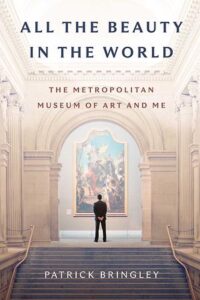

All the Beauty in the World: The Metropolitan Museum of Art and Me
Patrick Bringley
“This time, I arrive at the Met with no thought of moving forward. My heart is full, my heart is breaking, and I badly want to stand still awhile.”
After losing his brother to cancer, Patrick Bringley quit his desk job to seek solace he spent many hours in as a child: the Metropolitan Museum of Art. His role as guard let him fade into the background — a sentinel yearning for deep quiet. But even the most closed-off heart can be broken open by the beauty of art. Sketches, paintings, sculptures, ancient artifacts, musical instruments, and even block quilts whisper to Patrick as he moves through the galleries. And then one day he begins to wonder: with all the beauty contained within the walls, how much more is there outside them?
I don’t consider myself an art connoisseur, or even that big of a fan. I can recognize that a particular piece took skill, if not mastery, to complete, but “fine art” has never captured my interest (and don’t even get me started on the “modern” stuff). Bringley’s book, however, makes me think that maybe I’ve been missing something. Looking at art can be like looking into a mirror; he does a beautiful job of mapping certain pieces side-by-side with his journey from death to life. The artists and the situations and people they chose to depict were normal or extraordinary, beautiful or suffering, lost or found, ready to face life or shrink from it. They are us. Or maybe we are them. It’s a wonderful way to look at the world. My only quibble is that I wish the author had included photos of the art pieces he discusses. He’s got some sketches, but I think the impact would be greater with color photos.
Pick this up if you’re looking for a “quiet,” introspective read that focuses on art as a metaphor for life.
Photo by Annie Spratt on Unsplash